
God’s Humanity: Strengthening the Relationship
I derive strength from imagining that God prays for strength to do what is right.

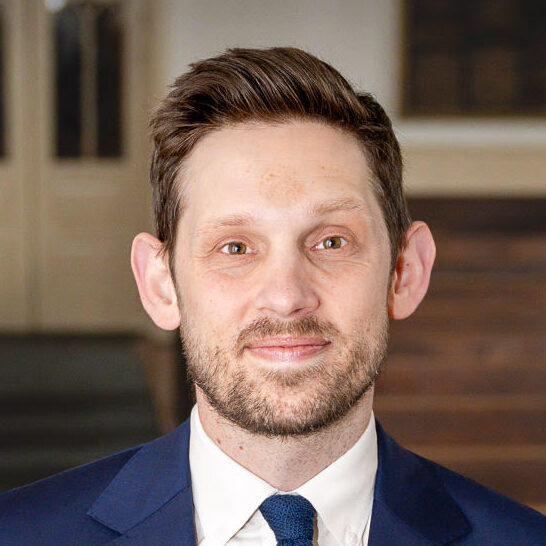
Rabbi Nathan S. Kamesar is rabbi of Society Hill Synagogue in Philadelphia. He serves as rabbinic liaison and is a member of the steering committee of Center City Kehillah, a network of communities representing the diversity of Jewish life in urban Philadelphia, and is a member of the policy board of the Jewish Community Relations Council of Greater Philadelphia. He also recently completed a term of service as Reconstructionist Rabbinical Association Representative to the RRC Admissions Committee.
Rabbi Kamesar graduated from RRC in 2018, where he served as president of the Reconstructionist Student Association and was honored with the Tikkun Olam Award for service to the college community. He also earned an M.S. degree in nonprofit leadership at the University of Pennsylvania in 2016 and was selected by his classmates to be the graduation speaker for that program. Before rabbinical school, Kamesar was an attorney at the law firm Skadden Arps. He earned his J.D. from the University of California, Berkeley, in 2010. Prior to law school, Nathan served two years with AmeriCorps*VISTA in Baltimore and Washington, D.C. The rabbi is a proud Oregon Duck having graduated magna cum laude from the University of Oregon in 2004 with a degree in economics. He and his wife, Caroline, both grew up in the Philadelphia area and reside in Center City with their daughters, Lila and Nina.

I derive strength from imagining that God prays for strength to do what is right.
We need to be sensitive to groupthink.

The fundamental goal of building Jewish community remains unchanged in 2024.

To be Jewish is to be part of a people—a people with a shared history, roots, a story and, yes, a land.

We don’t have to believe in supernaturalism to believe in a God who hears our prayers.

A broken heart is one of the most meaningful stances from which to open ourselves to the unknown.

Don’t let the literal meaning of the words of prayers obstruct your religious experience. And don’t let your religious experience keep you from formulating beliefs you can believe in.

How can we sanctify our on-line lives by acting according to our values? How can we use the resources on line to enrich our lives?