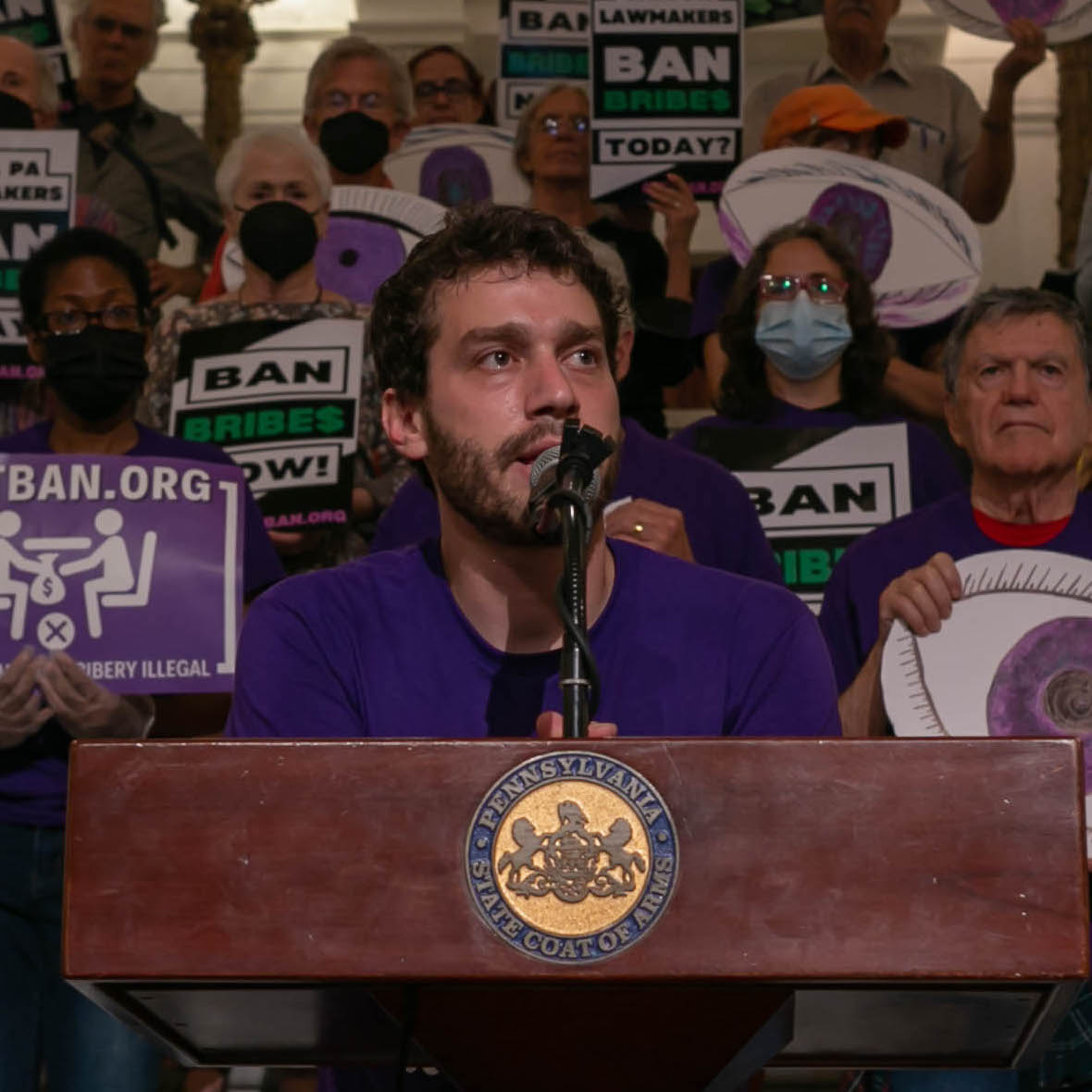
From April 30 to May 4, MarchOnHarrisburg (MoH) will be making a pilgrimage to the Pennsylvania State Capitol. We will march 60 miles through the Pennsylvania countryside from Reading to Harrisburg. On May 4, we will sacrifice in the State Capitol, engaging in nonviolent civil disobedience to advance bills to get money out of politics and strengthen democracy.
This will be MoH’s sixth time marching on Harrisburg. As a rabbi, for me, it is always more than a march. It is a sacred pilgrimage to offer a sacrifice at our civic Temple. It is of vital significance and of the utmost importance for the survival and success of our society.
Biblical Pilgrimages
The civilization that produced the Bible was centered around the First and Second Temples in Jerusalem, which stood for most of the years 1,000ish BCE to 70 CE The Temple was where the people interacted with each other, where people encountered their high-level public officials, where people sacrificed to their highest and holiest ideals, where big decisions were made, where the public treasury was and where power was concentrated. The Temple was where the Prophets preached about justice and where Jesus chased out the money changers (extortionary gatekeepers who sat between people and public power, like corporate lobbyists today). The Temple was, at times, a sanctuary of holiness. And in other moments, it was a busy hive of corruption and oppression.
People would make pilgrimage to Jerusalem three times a year and make a sacrifice in the Temple. They would march the long distance to the capital city — praying and feasting, eating and drinking with their community, and with people from other areas who also made the long march to consecrate themselves to their most cherished values.
We are making collective decisions out of greed and not in the interest of human need.
There was and is nothing inherently special or amazing about Jerusalem, except that it was geographically central like most capital cities. The rabbis of the Talmud (B.T. Pesakhim 8b) note that it didn’t have any hot springs and it didn’t even have good fruit. They conclude that if Jerusalem had natural resources or great food, people would be making the pilgrimage for the wrong reasons, because the pilgrimage and the sacrifice itself is the point.
Our Pilgrimage to Harrisburg
On the pilgrimage, we will encounter each other. As roughly 30 of us march from Reading to Harrisburg, we will walk and talk with each. Nobody will be looking at a screen, and we will be out of the office and breathing fresh air. We will eat together, and we will eat well. Home-cooked food will be provided by loving volunteers and allied organizations. We will be housed together along the route in houses of worship, and in the homes of local members and allies. We will raise awareness, host public educational events along the way, and show up in the media and go viral on social media (like this one from the last march, in the spirit of Isaiah 30:29, “Heartfelt joy like one marching with a fife.”) We will grow the movement, and we will build the community that undergirds all our success and forward momentum in making corruption illegal and advancing democracy.
The pilgrimage is an essential institution for a society to stay together. As the Roman Jewish historian Josephus wrote, “For it is a good thing for those that are of the same stock, and under the same institution of laws, not to be unacquainted with each other; which acquaintance will be maintained by thus conversing together, and by seeing and talking with one another, and so renewing the memorials of this union; for if they do not thus converse together continually, they will appear like mere strangers to one another.” (Josephus, Antiquities of the Jews, 4:204).
When we fail to make pilgrimage, we fall apart as a society, we collapse, and we suffer. In the aftermath of the Roman destruction of the Second Temple and Jerusalem, Rabbi Yohanan ben Zakkai was walking through the hills and taking in the extreme poverty wrought by Roman rule over Judea. He saw hunger and desperation: A woman picking bits of undigested barley out of horse poop, trying to scrape together a meal. He lamented his society’s collapse into oppressive Roman rule, and he said about his own people, “You were unwilling to repair the roads and highways for pilgrims going up to the Temple; now you have to keep in repair Roman guard posts and the roads that take people to work the royal plantations.” (Book of Legends, pp. 212-51, ARN 14.)
“When you see the face of the other, you are ordered and ordained to service.”
– Emmanuel Levinas
We march on Harrisburg to encounter each other and the public. When we arrive at the State Capitol, we seek to encounter our public officials and convince them to make their own corruption illegal and to democratize their own tightly gripped power.
Democracy is when we come together to make the decisions that govern our lives. The sovereign power in democracy is the people, as Alexis De Tocqueville wrote, “The people reign over the American political world as does God over the universe.” And our power is made real when we encounter each other and make decisions as a government of, by and for the people. The mechanics of democracy are simply various forms of encounters: speech, assembly, the press, religious expression, petitioning, debating, advocating, marching, protesting, door-knocking, tabling, voting, public art and so much more.
Corruption and money in politics prevent democracy from happening because it fundamentally prevents encounters between the people and our public officials. As it says in Deuteronomy (16:19), “Do not take a bribe, because a bribe blinds the eyes of the wise and distorts the words of the righteous.” No matter how wise and how righteous we imagine we are, bribery prevents us from seeing and hearing each other. This creates a systemic indifference with dire consequences. As Isaiah said (Isaiah 1:23), “Your rulers are rebels, partners with thieves. They love bribes and chase after gifts; the widow and the orphan’s cause does not come before them.” When corruption is legal and systemic, we suffer. In Pennsylvania, one in two children is poor. One in eight children lives in deep poverty, and one in six children goes hungry. Whether it is housing, health care, war, immigration, public transit, low wages, high prices or any issue, we are making collective decisions out of greed and not in the interest of human need.
In Pennsylvania, it is possible, legal and easy (if you have money) to influence, bribe and corrupt elections and elected officials. The decisions that shape our society are made in a corrupt eco-system that features unlimited gifts, unlimited campaign contributions, unlimited secret Super PAC spending, unlimited side jobs and a revolving door between being a public official and being a lobbyist. Our voice at the ballot box is distorted through gerrymandering, the electoral college, a lack of ranked choice voting, closed primaries and more. The lines of communication between the public and public power have been severed.
After we march to the State Capitol in Harrisburg, we will engage in nonviolent direct action to advance the Gift Ban, Ranked Choice Voting and our Money Out People In policy platform. We will be sacrificing in the Temple.
At its core, a sacrifice is an encounter. The Hebrew word for sacrifice is korban. Its Hebrew shoresh (root) is the same as the words for “to draw near,” “to encounter” and “to hug.” When we sacrifice, we encounter each other. When we encounter each other, we turn toward each other, and we feel responsible for each other. As Emanuel Levinas wrote, “When you see the face of the other, you are ordered and ordained to service.” And when we serve each other, the power of the Divine is made real. The priestly blessing, said in the Temple after sacrifices, prays that, “God’s face shines on you with grace; God’s face turns toward you and grants you peace.”
We will encounter each other on the pilgrimage, and we will encounter our elected officials when we sacrifice. We will be both doing and demanding democracy. We will act with responsibility, we will demand service, and we pray that our sacrifice will bring peace.