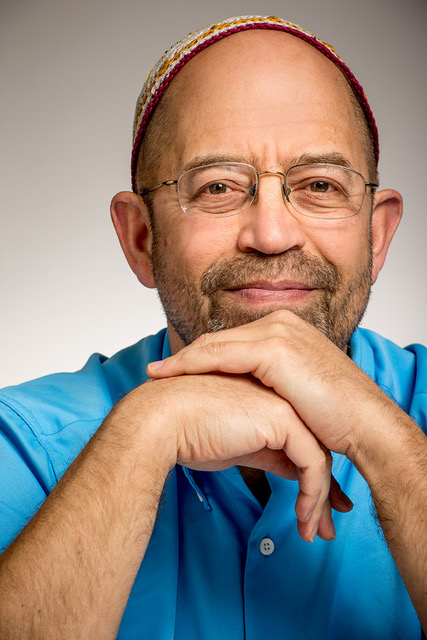
[Register for the course, “Antisemitism: Understanding Our Contemporary Moment,” Jan. 15-Jan. 29, 2026. Sponsored by Reconstructing Judaism and Project Shema. Image credit from Walt Stoneburner.]
In 1973, during the Yom Kippur War, Rabbi Baruch Chait set these words of Rebbe Nakhman of Breslov (1772-1810) to music:
Kol ha’olam kulo gesher tzar me’od, v’ha’ikar lo lefakhed k’lal.
The entire world is a very narrow bridge, and the most important thing is not to be afraid.
That song has since become a standard throughout the Jewish world; perhaps you have heard it or sung it. (You can listen to it on this video that I made with the Woodstock Jewish Congregation a number of years ago.) The sentiment is stirring and uplifting. And yet a question always lingers: How can a person live without sometimes being afraid? Life is often a dangerous and scary proposition, a narrow bridge indeed.
It turns out that Rabbi Chait slightly altered Rebbe Nakhman’s words, perhaps so that they might scan better rhythmically. The original version offers the nuance we are missing from the song. Nakhman said:
Kol ha’olam kulo gesher tzar me’od, v’ha’ikar she’lo yitpakhed k’lal.
The entire world is a very narrow bridge, and the most important thing is to not make yourself afraid.
Or, as I like to say, life is difficult enough; it doesn’t help if you freak yourself out! Each of us knows and understands this. When we feed our fear, we tend to move toward painful extremes: hypervigilance and hyperarousal, or numbness and paralysis. The grip of terror is exhausting and debilitating. Our bodies do not get to rest. We are unable to appreciate and be sustained by all of the simple yet glorious gifts of being alive. We forget that we can breathe deeply. We forget that we are much more than our emotional reactions. We forget to take hands with others as we cross the bridge, and we forget to enjoy the view from time to time.
As a Jew, I am deeply familiar with the inherited terror of annihilation that I carry — the unbidden anxieties and fears that these days we call “ancestral trauma.”
The Torah describes this state of being in a passage from Leviticus. The text is describing the curses that will befall the Israelites if they do not take care of the land and each other: They will be cast into exile and will become so terrified that “the sound of a driven leaf shall put them to flight. Fleeing as though from the sword, they shall fall though none pursues” (Leviticus 26:36). In such a state, we lose the ability to discern whether we are indeed in danger, and if so, to what degree, as we react to everything as a mortal threat.
This is no way to live.
As I reflected on Reb Nakhman’s words, I thought of Franklin Delano Roosevelt’s famous exhortation in his first presidential inaugural address. It was 1932, and the United States was mired in the depths of the Great Depression. FDR said, “The only thing we have to fear is fear itself.” Again, a powerful formulation, but what does it really mean? Are there not many truly fearful events in our lives? But Roosevelt’s complete sentence makes his meaning clear: “The only thing we have to fear is fear itself - nameless, unreasoning, unjustified terror which paralyzes needed efforts to convert retreat into advance.” (emphasis added)
As a Jew, I am deeply familiar with the inherited terror of annihilation that I carry — the unbidden anxieties and fears that these days we call “ancestral trauma.” The Holocaust in particular looms in my consciousness, the ultimate denouement of the historic message that it is fundamentally unsafe to be a Jew in the world. As antisemitism once again surges into the public arena from both the far right and the far left of the political spectrum, I am challenged not only by the very real dangers these trends pose to the safety of Jews, but also by the inherited Jewish terror that is triggered within me.
We must make the best decisions we can, assess the results and then adjust our courses of action as needed.
My hyper-aroused state can lead me to feel defensive, frantic, even panicked. The inherited messages of antisemitism tell me that I am isolated and alone, and must scramble for whatever safety I can find, wherever I can find it. These types of reactions are writ large in the Jewish world as a whole right now in the United States, in Israel and around the world. It is a struggle to separate our inherited fears from our assessment of present threats. I have deep compassion for my people and the challenges that we face. Yet we must find a way to heed Reb Nakhman’s instructions and walk this narrow bridge without succumbing to mindless and irrational fear.
The truth is that; no one, Jew or otherwise, is guaranteed safe passage through life. Panicked responses do not help us. It is a tenuous journey; I think that is why Reb Nakhman engaged the image of the narrow bridge. We do need to keep our wits about us. We don’t need to be driven by fear. We must make the best decisions we can, assess the results and then adjust our courses of action as needed. And let’s remember to hold hands along the uncertain way.
[This first appeared on the Substack “Turn It and Turn It.”]



2 Responses
How can I not be afraid, or at least, very concerned? As I write this, I have family in Israel, living in the shelters or the “safe” room. I’ve talked with them, but I fight the temptation to keep on calling. They know my thoughts and prayers are with them; they need to be able to concentrate on keeping themselves as safe as possible….Sue Greenberg
My journey from my good mother’s Roman Catholic practices to finding you is in its 72nd year. Honestly, I have proof. My interest in Reform Judaism was ignited in an interfaith nighttime celebration with candles when I was serving my Higher Power by living among and sleeping among the homeless 2010 – 2013.