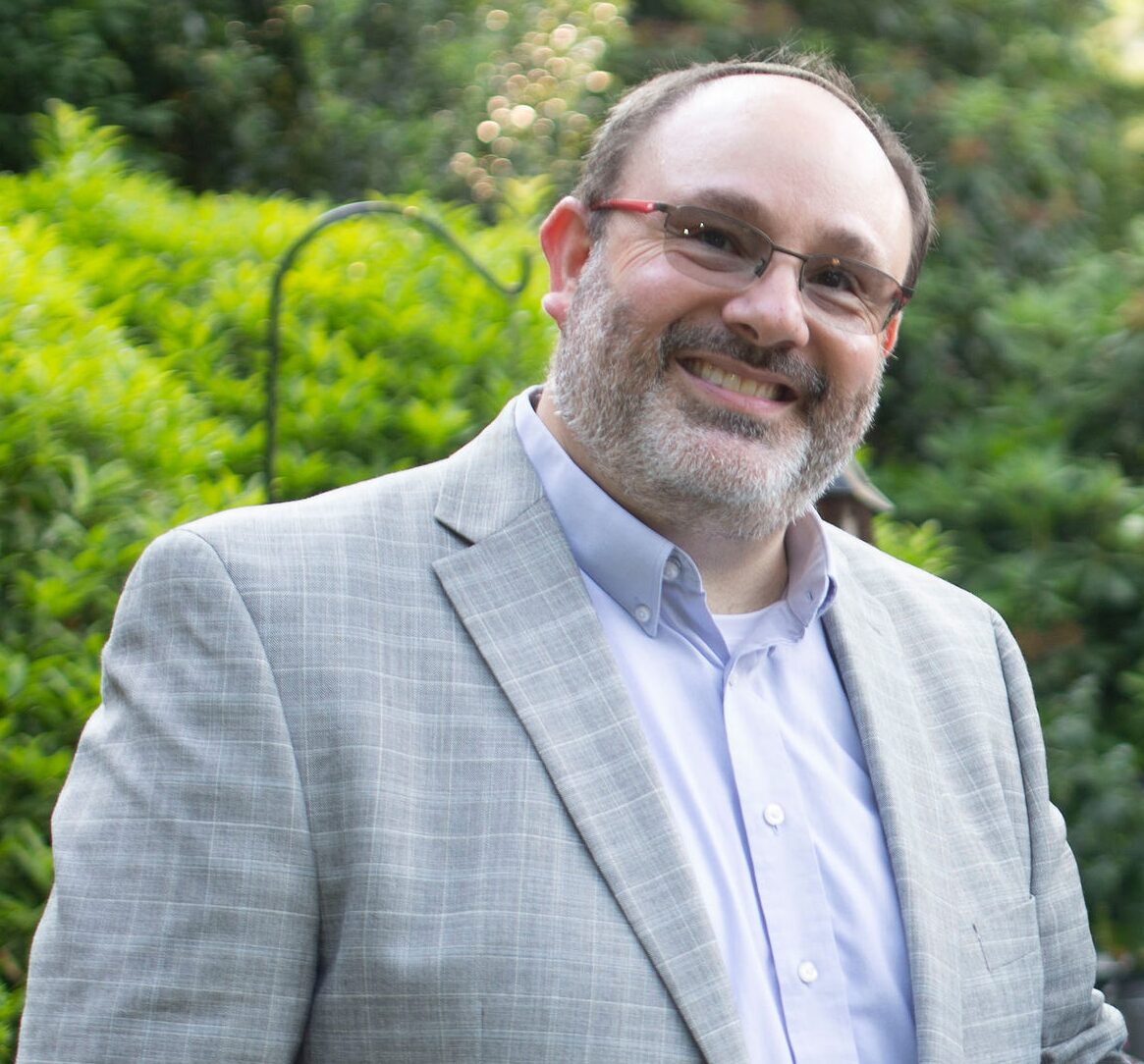
My partner Jen and I have fostered children for several years. One of our former foster teens had a significant drug addiction, and shortly after he began living with us, he accidentally overdosed on marijuana that had been laced with another substance. Jen called 911. In our rural town, emergency services are provided by volunteers. That night, it was our neighbors —people who answered a call not because it was easy, but because it was necessary — who showed up at our door. I was overwhelmed by their generosity and commitment. They didn’t just offer medical assistance; they embodied the core Jewish value that community flourishes through mutual responsibility and care. In my family’s worst moment, they left their homes and showed up to help.
That experience was transformative. It made me want to give back and contribute to the web of support that cared for my family. I walked into the fire department that spring, filled out a membership application and began training as a firefighter, and later, as an EMT. Since then, I have spent countless hours learning new skills, riding with the ambulance service, learning how to drive a fire truck and operate a pump, and responding to emergencies alongside an extraordinary group of first responders.
These experiences have taught me not only practical skills but also profound lessons about what makes community strong, resilient and truly sacred. The lessons I have learned in moments of crisis and in service are — at their core — the very same ones we need to build vibrant Jewish community: not a community in name only, but a real, living community bound together by shared values, meaningful obligation and active support for one another. These aren’t abstract concepts. As a nonprofit CEO, I see every day how these values sustain our staff, clients and volunteers, ensuring that everyone feels valued, respected and included.
The Hebrew phrase Kol Yisrael arevim zeh bazeh, “All Jews are responsible for one another,” isn’t just a platitude; it is the backbone of Jewish life. Jewish communities have endured and flourished for generations by taking seriously the idea that our fates are intertwined. When my family was in need, neighbors came running. And although I am the only Jewish member of my department, my faith has been deepened by watching their compassion and bearing witness to how they show up to lend a hand. When I was called to serve, the sense of gratitude I felt — and the recognition that now it was my turn to give — anchored me in something far larger than myself. In practice, mutual obligation isn’t just about big gestures. It lives in everyday acts.
To build vibrant Jewish community, we must be bound together by shared values, meaningful obligation and active support for one another.
To that end, I want to share some of the Torah I have learned along the way and how it has shaped my personal life and work.
Six Lessons for Building Meaningful Community
1. Curiosity About ‘Why’
One of the earliest lessons I learned as a first responder was never to settle for treating symptoms — always look for the underlying “why.” My training officer, Cathy, modeled how to listen deeply to our patients’ stories to help us piece together the bigger picture. The same is true in Jewish tradition; the daughters of Zelophehad (Numbers 27), who come to Moses with a plea for inheritance, have a true concern that lies beneath the surface. Moses’ ability to understand their concerns informs his response. Both in emergency response and in Jewish communal work, curiosity is key. Asking questions, listening with real openness and being willing to dig deep allows us to meet people’s needs lovingly and thoughtfully. And in my work with staff and clients at Jewish Family Service, I try to embody this lesson every day, striving to support not just the surface problem, but the whole person.
2. Showing Up Matters
Jewish tradition elevates the act of showing up — whether it’s assembling a minyan, comforting the mourner or standing for justice. Last year, after a long day of meetings, I was driving home when I received an emergency dispatch and drove straight to the scene. Inside the house, a frightened family was in chaos, and the patient was scared and confused. It wasn’t just my medical skills that mattered, but the calm presence I brought. The patient’s adult daughter later thanked me not only for coming, but for the way I was present for them in a hard moment. In community life, too, presence is transformative. Showing up in times of need — fully, without distraction — signals to others that they matter, that they belong and that none of us is alone. In the midst of incredible changes in the human service sector and funding for agencies serving at-risk populations, a calm approach leads to better communication and better outcomes for the agency and for our client community. Resilience and trust build from the habit of presence — physically, emotionally and spiritually.
3. Laughter Is a Salve for the Soul
Judaism is deeply honest about the reality of hardship and equally insistent about the importance of joy. Humor and celebration are woven into our rituals not as distractions, but as essential tools for survival and connection. Mel Brooks once quipped that Jewish humor is the way we’ve survived Jewish history. I have found this to be true after difficult emergency calls; laughter with colleagues became not just a release, but a salve for the soul. It is impossible not to bring hard calls home with you, just as it is impossible for many Jewish professionals not to bring work home. We are passionate about our work and the communities we serve, and it is natural to want to work hard and difficult to find space when our personal lives intersect so intimately with our professional work. But joy and release matter. These moments aren’t frivolous; they are oxygen. Communities that cultivate joy and laughter are more supportive, more creative and simply more fun to belong to.
Showing up in times of need — fully, without distraction — signals to others that they matter, that they belong and that none of us is alone.
4. Self-Care Is Good Care
Jewish tradition teaches that to be able to care for others, we must also care for ourselves. Endurance, in leadership or caregiving, comes from renewal. One of my teachers, Rabbi Linda Holtzman, used to say, “One tuches (‘bottom’) can’t dance at two weddings!” I try to model healthy boundaries for my staff, setting expectations that everyone can respond in ways that are sustainable. Serving as a first responder often requires exposure to traumatic situations and necessitates developing coping mechanisms. And in my professional work, I tend to set my own needs aside so that I can serve the organization. Through my volunteering, I have learned from department members with decades of experience that self-care isn’t selfish; it’s ethical, allowing all of us to continually and consistently serve our communities well.
5. Don’t Work in the Dark
One day on shift, an EMT mentor named Rod found me working by the dim light in a nursing-home room. He grinned, flipped on the light and quipped, “We don’t have to work in the dark.” In life, it is easy to get lost in the dark, focusing so intently on the immediate problem that we lose sight of resources and perspective. Jewish wisdom calls us to step back, remember our values and orient ourselves through a more expansive vision. As a leader, this lesson has helped me step back at critical moments, gather support and remember that even in urgency, strategy and clarity are needed. Jewish community thrives when we embrace both quick action and reflective planning. The metaphor of not working in the dark has made me a stronger organizational leader in critical moments.
6. Growth, Learning and Change
This past summer, I signed up for a fire academy course to learn how to drive large fire apparatus. I was apprehensive, but my instructor encouraged me to see it as an opportunity: “When was the last time you did something for the first time?” What an incredible offering! Jewish life prizes growth, learning and adaptability. Thriving communities encourage new roles and experimentation — whether updating a ritual, learning new skills or responding creatively to new challenges. The act of trying something new keeps both individuals and communities vibrant and responsive. Whether it is patient care, learning how to drive a fire apparatus or charge an attack line, finding joy in the new experiences has become a hallmark of how I approach my work in the Jewish community. And it has allowed me to be more responsive to the needs of my staff and more available to support the changing needs of the community we serve.
Closing Reflections
Serving as a first responder has deepened my understanding of what makes Jewish community meaningful and resilient, and it has helped me become a stronger Jewish communal leader. It is not just about shared rituals or history, but about the lived reality of caring for one another: mutual obligation, presence, laughter, self-renewal and growth. Communities that invest in these practices don’t just survive; they flourish. The Torah of our day is written every time we show up, uplift and weave our lives together. As I continue to learn from the incredible first responders around me, my hope is that Jewish spaces everywhere can also lean into these timeless lessons. And I hope that I can continue to improve not just my patient care, but my professional practice as a rabbi and nonprofit executive.


2 Responses
Love these insights. Also want to say, as a colleague of Rabbi James, how much I am moved by the way this rabbi “walks his talk” in so many aspects of life.
James, the way in which you have shown the relationship between your volunteer service in the community and your life as a Jewish communal professional is nothing short of spectacular. I’m proud of you.