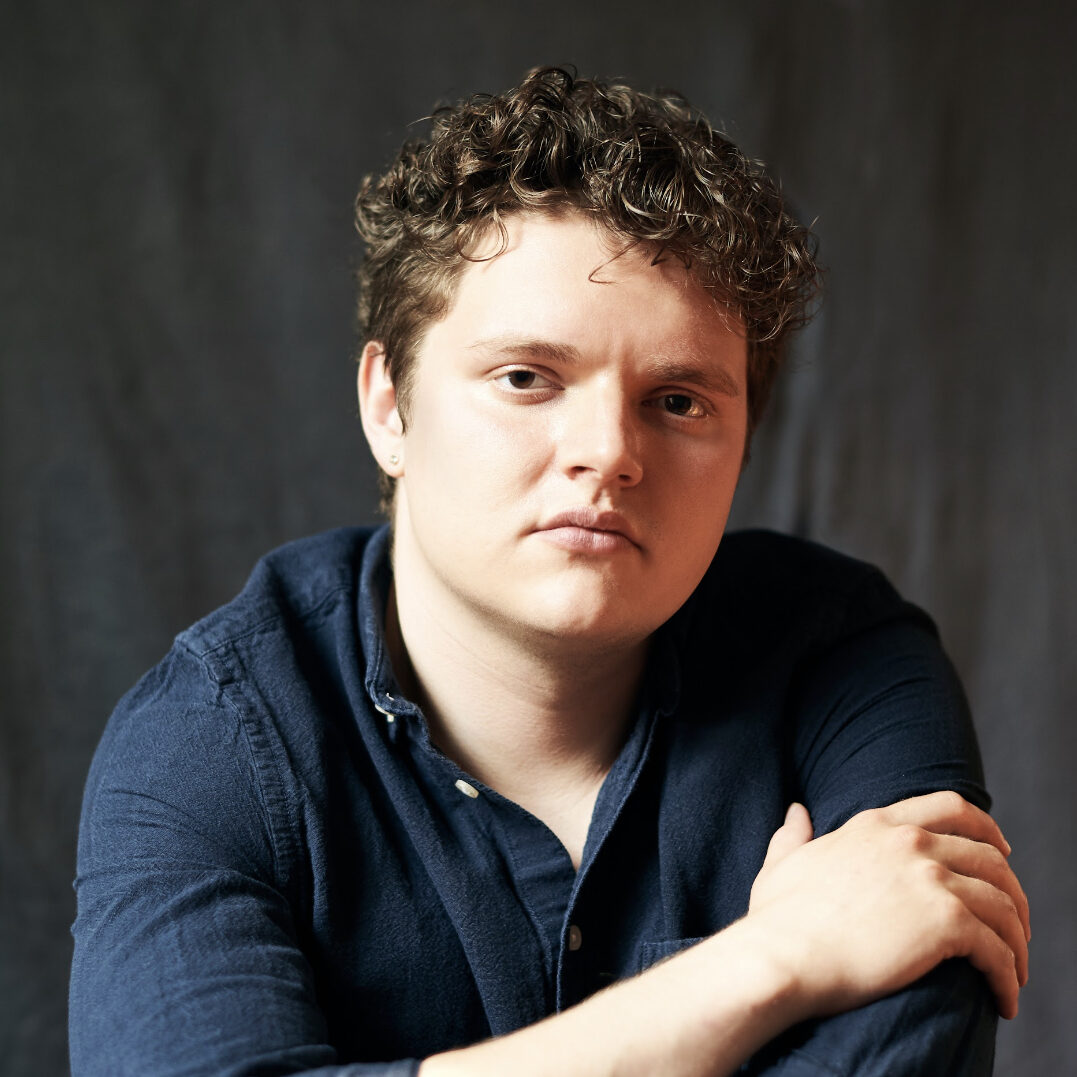
When my lifelong friend/director/co-creator Lila Weitzner and I initially began talking about an artistic collaboration, which would someday become the one-person show kaddish (how to be a sanctuary), it was September of 2023. Ever since my days as an acting student at the University of North Carolina School of the Arts in Winston-Salem, N.C., I had been toying with adapting the raw journals of my late paternal grandfather, Saul N. Sherman, for some kind of theatrical project.
I never knew my grandfather, who passed away in 1992, but I always felt spiritually close to him: Saul was my namesake. My dad had imparted upon me his father’s distinct sense of humor, and I would even inherit my grandpa’s tallis bag, which I still use to this day whenever I attend shul. This enduring sense of connection was only enhanced by having access to Saul’s memoirs.
Grandpa Saul detailed his upbringing as a first-generation Jewish American in Newark, N.J., during the Great Depression, along with how the suffering of his family in the Holocaust motivated him to enlist as a combat soldier during World War II. As he approached the end of his life, my grandpa expressed a profound grief over the direction of his country, becoming increasingly jaded as he realized how the forces of national mythology and political corruption carried so many of his comrades to their deaths overseas in the so-called “Good War.”
This sentiment dovetailed with some of my own experiences growing up in Washington, D.C., during the War on Terror and the Great Recession, witnessing ever more political contradictions come into play during the mass protests of the 2010s: from Occupy Wall Street to the Black Lives Matter Movement to the fight against constructing the Dakota Access Pipeline at the Standing Rock Sioux Reservation. During the George Floyd uprisings in the summer of 2020 and the lead-up to the Jan. 6 Capitol attack in 2021, I would have my own violent encounters with the local police department and invading militia groups like the Proud Boys. For me, a shared narrative was coming into view, tethering my developing political consciousness to the memory of my grandfather.
Lila and I, though living in New York City at the time, both attended the 2023 Yom Kippur services at our home congregation of Adat Shalom in Bethesda, Md. Rabbi Fred Scherlinder Dobb gave what would be his last sermon as a full-time member of the clergy at our synagogue. In it, he spoke of what it means to “die before you die.” The question left for us to ponder was: What does it mean to kill off the part of ourselves that holds us back from devoting our lives to radical action, especially in light of the disasters we were seeing unfold all around us?
We agreed that much more had to be done to encourage other American Jews to see a different story: that of the Palestinian people and their resistance against oppression.
I took this very seriously. Earlier that year, I had already begun involving myself with organizations in the Palestine Solidarity Movement, supporting the Not On Our Dime campaign against New York-based charities providing material assistance to the Israeli Defense Forces and illegal settlements in the West Bank. After Oct. 7, I helped marshall the rally at Grand Central Station against the devastating violence leveled against Palestinians in Gaza and sought to garner public support for the Freedom Theatre of Jenin when it was raided by Israeli forces. Awash in feelings of helplessness and despair, action became my antidote; I decided (rather hastily) to join a 10-day protective presence shift in the region of Masafer Yatta, part of Area C of the Occupied West Bank (the setting of the Oscar-winning film “No Other Land” and the subject of an Evolve essay, Settler Violence in the Occupied Territories: Masafer Yatta), working alongside Palestinian and Israeli organizers with the Center for Jewish Nonviolence to defend Palestinian communities from the drastic increase in Jewish state-settler attacks.
Soon enough, a year had passed — and what a year it had been. Lila and I reconvened to discuss our project again in the fall of 2024. While we knew there was certainly work to be done to motivate the broader U.S. public and politicians to change their tune and to stop supporting Israel’s actions with near-total impunity, we fervently agreed much more had to be done to encourage other American Jews to see a different story: that of the Palestinian people and their resistance against oppression. It was coupled with the fact that the neo-fascist tendencies rising across so much of the world were not mere glitches, but perhaps features of the societies so many of us were raised to identify with.
We understood that the struggles of oppressed groups waged across history are, in fact, interconnected. How might we illustrate this for others? By placing my own various experiences in quasi-conversation with those of my late grandfather, across time and space via the spiritual technologies of the theatre (with help from some Yiddish folklore), maybe this kind of story could reach somewhere into people’s hearts where newspaper headlines and vitriolic arguments could not.
Lila and I have had many conversations over the years about how our Reconstructionist values deeply inform our solidarity with Palestinian folks; the pluralistic vision constructed by Rabbi Mordecai Kaplan was set in us from a young age.
Lila and I have had many conversations over the years about how our Reconstructionist values deeply informed our solidarity with Palestinian folks; the pluralistic vision for religion in American society constructed by Rabbi Mordecai Kaplan had been set in us from a young age. It was deeply grounding to think of “god,” less as some kind of supernatural architect, but in the Kaplanian sense as the sum of all processes that allows human beings to achieve a greater sense of ethical refinement and self-actualization.
For me, elements of Kaplan’s philosophy easily complemented my burgeoning passion for studying the history of Yiddish radicalism in my family (Saul’s father, Harry, was involved with the Jewish Labor Bund in Poland) as well as the Jewish Liberation Theology articulated by the late theologian Marc Ellis, and the “heretical” traditions expressed by Polish Marxist journalist Isaac Deutscher in his 1958 essay, “Message of the Non-Jewish Jew.” For Lila and myself, these ideas also existed in dialogue with threads from the Black Radical Tradition, which we were exposed to as white Jewish theater students receiving a critical education at a predominantly Black public arts high school in D.C., the Duke Ellington School of the Arts. The two of us have lived so much of our lives enveloped in the tension between the particular and the universal; existing in that space allowed me to define Jewishness for myself in such a way where I could fully embrace my highest values.
These moments we are living through demand more from us than simply being a witness. They demand that we take risks. They insist upon our solidarity and that we do the right thing against all odds.
After months of edits, revisions and rehearsals, we mounted a highly successful performance of kaddish (how to be a sanctuary) during the Edinburgh Fringe Festival in Scotland, in early August of last year. A couple of weeks ago, we concluded a weekend run of the show at the historic Plays and Players Theatre in Philadelphia. Both productions were profoundly cathartic moments for us. We put up our show for close friends, family and strangers — Jews and non-Jews, Americans and non-Americans. Across all audiences, we received phenomenal feedback. But the most important feedback I received came from a new friend whose family hosted me during my solidarity work in Palestine, who had taken the time to read the play:
What made it especially meaningful for me is that you did not forget us. You didn’t forget Masafer Yatta, nor the names and stories that matter. It means so much that we were present in your work — seen, remembered, honored.
Remaining faithful to that sense of honor requires continued engagement. It was never going to be enough for me to do a play about it and move on. As I prepare myself for another round of protective presence in the West Bank with CJNV (for three months this time, as part of their 2026 Hineinu cohort), I know well that these moments we are living through demand more from us than simply being a witness. They demand that we take risks. They insist upon our solidarity and that we do the right thing against all odds. This is my sacred inheritance from Grandpa Saul. I will never forget it.

2 Responses
As long as you fight from a place of love and compassion, Grandpa Saul lives on and on and on. May Gods spirit of hope empower you each day Sam
Love always wins
A powerful and clear statement of your core beliefs. Thanks for sharing what is in your heart and on your mind. It gives me pause to consider a new perspective.